It’s been a strange and fascinating year to be a Stephen King fan. As I sit here in 2026, looking back, the landscape feels utterly transformed from just a year ago. The conversation no longer orbits solely around the big screen premieres; it hums in the digital ether of Video on Demand platforms. The catalyst for this shift, for me, was the unexpected second wind of Edgar Wright’s The Running Man. That film, which had a somewhat muted theatrical reception in late 2025, has found a roaring, defiant new life online. It’s become a #4 bestseller on Prime Video, a testament to how a story can find its true audience not in the hushed darkness of a cinema, but in the living rooms and on the tablets of viewers who crave its specific, R-rated brand of dystopian chaos. This wasn't just a movie release; it was the opening act for what felt like the "Year of King," a relentless parade of adaptations that pushed his work into every corner of our screens.
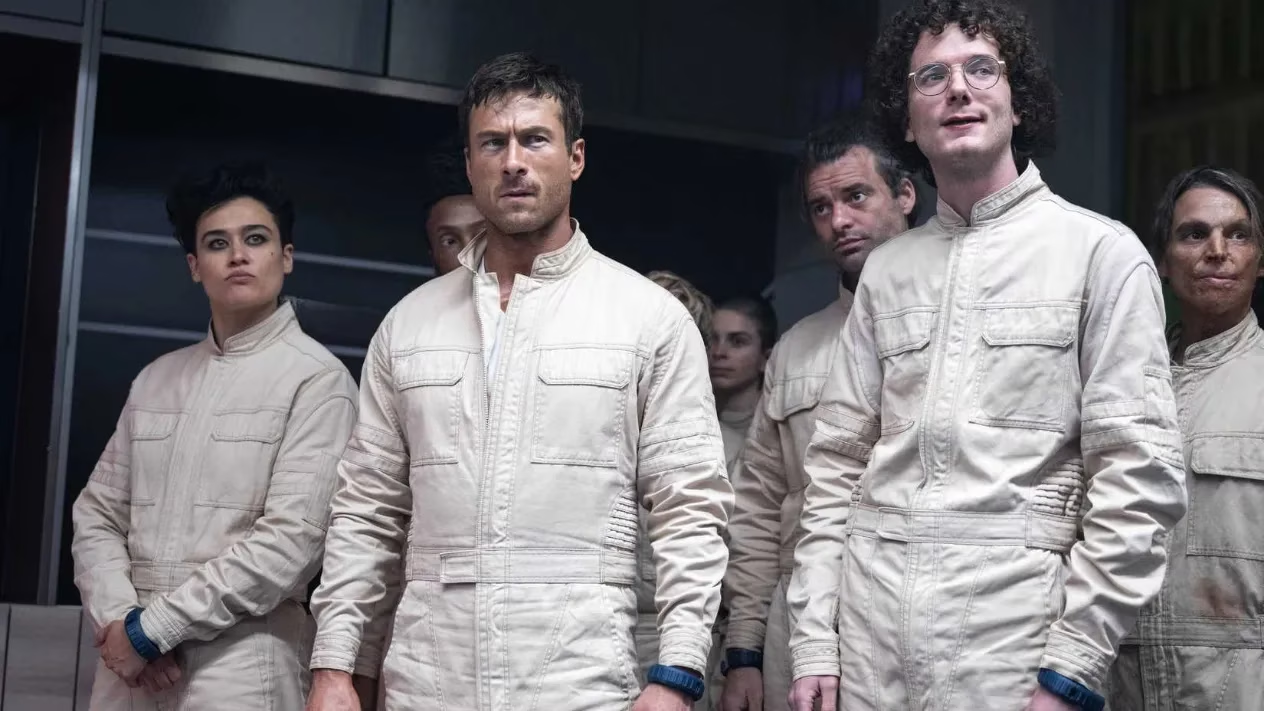
The journey of this new Running Man is a story in itself. Glen Powell’s Ben Richards felt different from Schwarzenegger’s icon—more desperate, perhaps more human in his fury. The world Wright built was sleek, brutal, and terrifyingly plausible. Yet, I remember the mixed whispers when it left theaters with a $69 million global haul against its $110 million budget. Some called it a miss. But VOD rewrote that narrative. Suddenly, the film's infectious energy, those thrilling set pieces Alex Harrison wrote about in his review, weren't constrained by a weekend box office. People could discover it, dissect it, and champion it on their own time. The divide between its 63% critical score on Rotten Tomatoes and its 78% audience rating on the Popcornmeter says it all: this was a film for the fans, and they found it.
Harrison’s review always stuck with me. He called it "an undeniably fun time" but felt something was "lost in the journey from page to screen." Watching it at home, I pondered that. King’s 1982 novel is a bleak, relentless satire. Wright’s film is a visceral action-thriller. Maybe what was "lost" for some critics was simply transformed for a new medium and a new era. The film’s success isn’t a rejection of the book, but proof of its adaptable, enduring core.
And The Running Man was just the beginning. 2025 bled into 2026 with a King tide that felt unprecedented. It was like every studio and network had a King project in their pocket:
-
The Return to Derry: HBO’s IT: Welcome to Derry prequel series arrived, diving deep into the town’s cursed history long before Pennywise terrorized the Losers' Club. It was a different kind of horror—slow-burn, atmospheric, and deeply unsettling.
-
The Long Walk: Francis Lawrence finally brought King’s haunting first novel to life. A stark, psychological thriller about a deadly walking contest, it was a brutal contrast to the glitz of The Running Man.
It felt like we were living in a constant state of King. One week, I’d be analyzing the VOD charts for The Running Man. The next, I’d be immersed in the foggy streets of Derry, or feeling the aching exhaustion of The Long Walk. The genres spanned from sci-fi action to gothic horror to dystopian drama, yet the throughline was always King’s fascination with pressure, fear, and the human spirit under duress.

This year has fundamentally changed how I view adaptations. The theatrical run is just the first draft of a film’s legacy now. The Running Man’s VOD triumph is a blueprint: a film can be a conversation starter long after its premiere. Its ensemble cast—Powell, Josh Brolin as the chilling Dan Killian, Colman Domingo, Michael Cera, Lee Pace—found a new audience one stream at a time.
So, what does this mean for the future? If 2026 has taught me anything, it’s this:
-
The Window is Wider. A film’s success is no longer a opening-weekend verdict. Digital platforms offer a second chance, a longer tail, and a more nuanced measure of impact.
-
King’s World is Limitless. From prequel series to long-awaited novel adaptations, there’s no template. Each story finds its own format, its own tone, and its own moment to connect.
-
The Audience Has the Remote. We, the viewers, collectively decide what resonates. We kept The Running Man alive. We made it a hit on our own terms.
As the year rolls on, I’m left with a head full of images: Powell running for his life, the grim faces of the walkers, the ominous drains of Derry. It’s been overwhelming, exhilarating, and a little bit terrifying—much like reading a King book for the first time. The man’s stories are more than just movies or shows; they’re events, cultural touchstones that now unfold across multiple screens and timelines. And as for Ben Richards? He’s still running. Only now, he’s running straight into our homes, and he’s winning. 🏃♂️💥
Leave a Comment
Comments