Disney’s long-running experiment with transforming its animated classics into live-action spectacles has entered a fascinating new era. As the summer of 2026 unfolds, the studio is preparing to release the live-action Moana on July 10, a project that follows closely on the heels of the unexpectedly massive success of Lilo & Stitch. That reimagining, which roared past the billion-dollar mark worldwide just last year, proved that a film does not need to be drawn from the most iconic vault titles to become a cultural phenomenon. The original Lilo & Stitch was a charming, modest hit in 2002, earning $274.7 million globally on an $80 million budget. Yet its live-action counterpart captured a contemporary audience in a way few predicted, suggesting that the blueprint for future adaptations may lie not in guaranteed franchises, but in beloved stories with room to grow.
While the world waits to see how Moana performs, industry watchers are already scanning the horizon for Disney’s next move. The Frozen franchise, with its $2.6 billion animated legacy, seems like the obvious heavyweight contender. However, a live-action Frozen will almost certainly remain on hold until the animated trilogy is complete. In the meantime, another candidate has emerged from the mid-tier of Disney’s animated library, one that offers a completely different flavor of nostalgia and creative possibility. That film is Wreck-It Ralph.
Released in 2012, Wreck-It Ralph introduced audiences to the arcade villain with a heart of gold, Ralph, who embarks on a journey of self-discovery across a dazzling array of video game worlds. It was a critical and commercial success, built not on a princess narrative but on pixelated brawn, candy-colored chaos, and a surprisingly tender friendship. Now, over a decade later, the idea of a live-action Wreck-It Ralph feels not just plausible but thrillingly inventive. Unlike fairy-tale forests or oceanic quests, this adaptation would demand a full-throttle collision of practical filmmaking, cutting-edge visual effects, and wildly imaginative production design. The very challenge of it is part of the appeal.
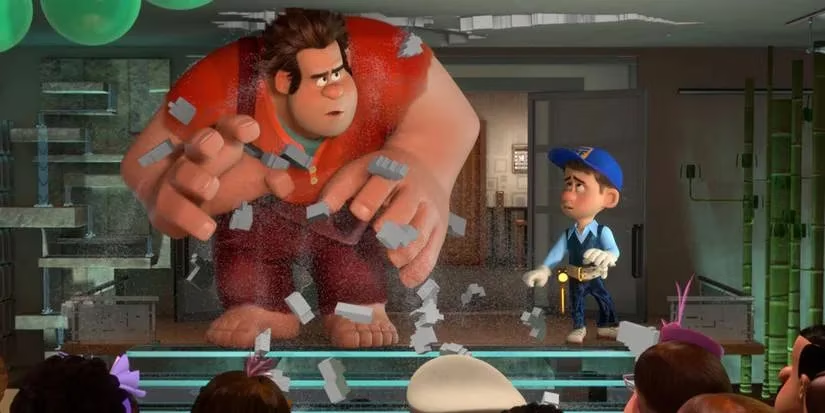
One of the most exhilarating aspects of a live-action Wreck-It Ralph is the casting playground it opens. The original animated feature delights in size contrast: Ralph towers over the residents of Niceland, and Vanellope von Schweetz is practically pocket-sized beside him. Translating this to live actors would allow the studio to lean into height disparity in a way no other Disney remake has attempted. For the role of Ralph, the casting directors could look to physically imposing performers with genuine warmth. Joonas Suotamo, who stands at an imposing 6-foot-11 and brought gentle soulfulness to Chewbacca in the Star Wars sequels, embodies the perfect blend of might and tenderness. Another inspired option is Boban Marjanović, the 7-foot-4 Serbian basketball star turned actor, whose charisma and comedic timing could make Ralph both intimidating and instantly lovable.
Counterbalancing such a giant would require actors who can project enormous personality from much smaller frames. Vanellope, the glitchy racer with a razor-sharp wit, could be brought to life by someone like Hayden Panettiere, whose 5-foot stature and feisty screen presence align beautifully with the character. For the ever-optimistic Fix-It Felix, a performer such as Seth Green—standing at 5-foot-4 and steeped in comedy—would capture the role’s earnest fussiness. Kevin Hart’s explosive energy at 5-foot-3 could also work brilliantly. And rounding out the core quartet, Sergeant Tamora Jean Calhoun, the hard-edged commander from Hero’s Duty, could be portrayed by Emilia Clarke, whose 5-foot-2 frame belies a proven capacity for steely authority and depth. A cast assembled with such deliberate physicality would immediately distinguish this adaptation from anything audiences have seen before.
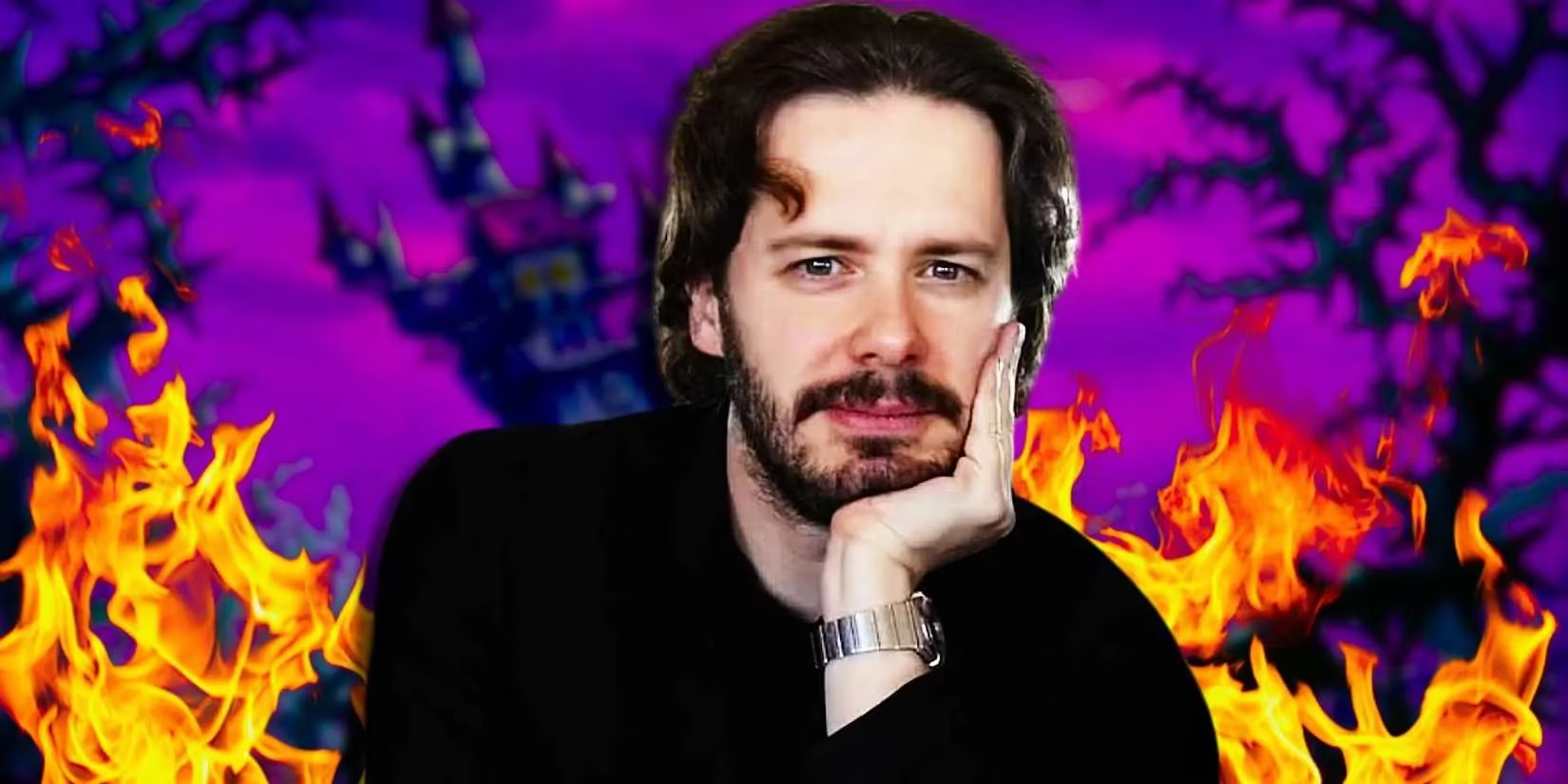
The question of who would helm such a visually audacious project is just as captivating. Bringing a virtual arcade universe into physical reality demands a director fluent in stylized action, vivid color palettes, and heartfelt character moments. Edgar Wright’s name rises to the top of that list. His work on Scott Pilgrim vs. the World remains a masterclass in translating video game aesthetics into live-action cinema, blending whip-smart editing with genuine emotional stakes. Few filmmakers can balance kinetic comedy and sincere storytelling as effortlessly as Wright, making him an ideal shepherd for Ralph’s journey.
Other compelling candidates also exist. Brad Bird, whose animation roots with The Incredibles are matched by his live-action prowess in Mission: Impossible – Ghost Protocol, understands how to construct set-pieces that serve character. Gore Verbinski, with his experience on both the animated Rango and the massive-scale The Lone Ranger, has navigated the intersection of stylized worlds and practical filmmaking before. Even the Tron directors Joseph Kosinski and Joachim Rønning could bring their unique fluency with digital realms to a project that would require extensive virtual production stages and motion-capture integration.
Technically, a live-action Wreck-It Ralph represents a monumental undertaking. The film would need to build the candy-coated racetracks of Sugar Rush, the stark metallic corridors of Hero’s Duty, and the retro charm of Fix-It Felix Jr. as tangible environments. This would likely involve a hybrid approach: enormous physical sets augmented by the same StageCraft LED volume technology used in The Batman and Disney’s own The Mandalorian, combined with practical animatronics for secondary characters and cutting-edge digital effects for the more fantastical elements. Yet for all its technical demands, the greatest asset of the adaptation remains the enduring warmth of its story. Ralph’s search for identity and belonging, and his bond with Vanellope, is a narrative that resonates across generations. It is a tale about misfits finding their place, delivered with a sincerity that would shine even brighter when performed by actors in a tactile, immersive world.
In an industry sometimes criticized for recycling the same crown jewels, Wreck-It Ralph offers Disney a path to surprise audiences once again. It is not the most obvious choice, but—as Lilo & Stitch so persuasively demonstrated—the modest hits can yield the greatest rewards when reimagined with care. With a thoughtful cast, a visionary director, and a commitment to practical wonder, a live-action Wreck-It Ralph could very well become the studio’s next billion-dollar phenomenon, a film that honors its digital origins while crackling with the electricity of real-world movie magic.
Leave a Comment
Comments